22 April to 16 May 2025
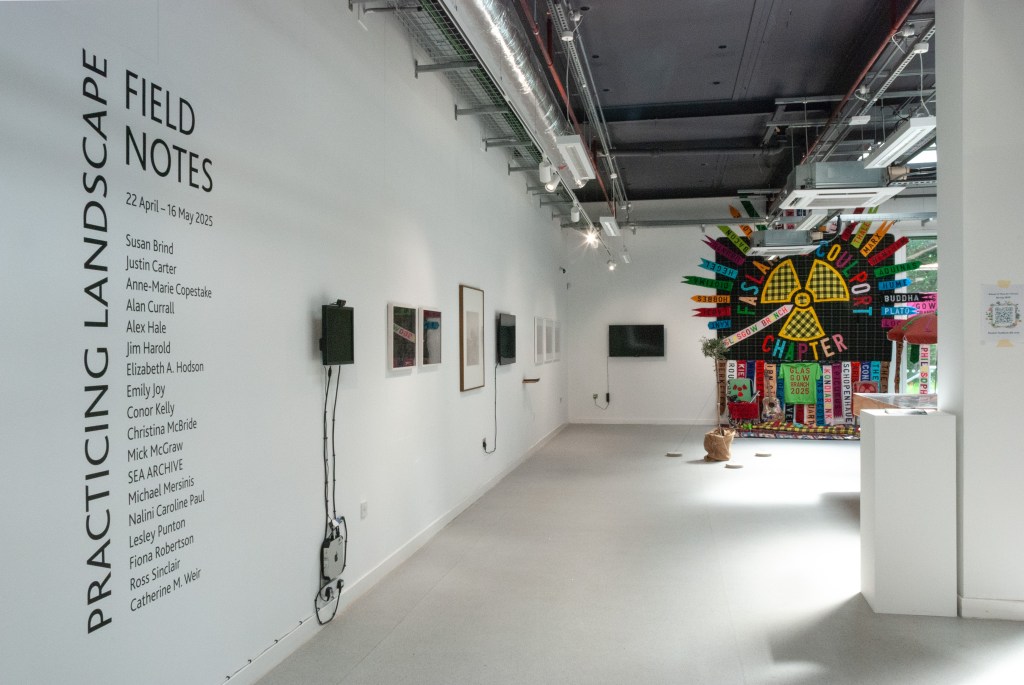
Practicing Landscape: Field Notes is the title of an exhibition presented at Annex Gallery, in the Stow Building of Glasgow School of Art. Gallery coordinator, James Hutchinson invited members of Reading Landscape to create an exhibition, in discussion with the GSA Garden Society, which would respond to the gallery’s proximity and relationship to the building’s recently developed garden and grounds.
Click on the link to each contributor below for more information about the work shown:
Susan Brind & Jim Harold, with Alex Hale / Justin Carter / Anne-Marie Copestake / Alan Currall / Elizabeth A. Hodson & Emily Joy / Conor Kelly / Christina McBride / Mick McGraw /Michael Mersinis / Nalini Caroline Paul / Lesley Punton / Fiona Robertson / SEA ARCHIVE / Ross Sinclair / Catherine M. Weir
For the final exhibition of this academic year, Annex Gallery presents Practicing Landscape: Field Notes, which contains works by members of the GSA research group, Reading Landscape, in discussion with the GSA Garden Society. Reading Landscape is the longest running of all the School of Fine Art research groups, having formed in 2014; and it is also the largest, having twenty-nine members. Sixteen members and three invitees are showing work in the exhibition, each of whom cultivates a different relationship with landscape, and approaches it from different subject positions. This diversity is reflected in the forms and disciplines present, as well as in the materials being utilised. Often, objects that might initially appear to have been made using fairly conventional means in fact contain unconventional materials drawn from natural (or, indeed, unnatural) environments rather than from art production facilities or shops.
The exhibition is intended to connect the inside to the outside, to simultaneously generate a sense that the gallery walls have been dissolved – allowing access to the immediate (and wider) spaces beyond – but also form a container in which we can think about the spaces we move through and between to get here (but perhaps do not notice), or seek out when we need to escape the city or consider the world from an ecological perspective. This connection is generated in an immediate sense through Justin Carter’s work, which utilises rust from the railings that demarcate the land occupied by the Stow Building to make the ink he has used to produce his print. This process will be rendered live throughout the exhibition, as Justin will be present in the gallery making ink, ready to be put to work in the production of new images. Nalini Caroline Paul’s work also makes use of the space just outside the gallery doors. On the opening of the exhibition, Nalini will perform a live reading of a set of new poems that explore migratory identity, before tearing them up and burying them in the piano planter in the GSA garden. Her work asks what will ‘grow’ from these words and matter in the coming year, the work only ‘ending’ in twelve months’ time, when she will return to the site to see what remains and how the site has been transformed.
Conversely, a potted olive tree has been placed inside the gallery by Michael Mersinis. This tree has travelled to Glasgow from Gaza, and – until it has assimilated – is unable to be planted in Scottish soil. The tree has been removed from distressed circumstances and will remain in the gallery for the first year of its time away from its homeland, where it will be tended and cared for both by the artist, and by you, the community that makes up the gallery audience. For the duration of the exhibition, it will gaze up at Ross Sinclair’s work, and wonder what it’s got itself into, seeing as it does, a representation of a protest against the presence of weapons of mass destruction a mere one-hour drive (or two-and-a-half-hour cycle) from the gallery. The majestic west coast, along which Sinclair walks, listening to philosophical treaties’, from ancient to modern, seem incongruous in the face of the threat that lurks beneath the waters of Gareloch and Loch Long. Similarly divisive is the wall built by the Romans to limit the movement of people across Scotland’s central belt, which represents the starting point for Mick McGraw’s book. McGraw documents a further lurking threat, in this case a set of ‘Lillia’, which appear as lilly ponds along the wall’s route, but are – in fact – traps, containing as they do sharpened posts intended to be fatal to anyone who falls, or dives, into the pond’s water.
Back above ground, a bizarre terror is haunting the allotments in Riddrie. A giant green head has formed where the land should be flat and fertile, and out of its mouth emerges the artist-performer (and allotment holder?), Fiona Robertson. Allotments are, of course, urban gardens sited where an industrial populace seeks a small outdoor space for recreation and sustenance, and here the unpredictable side-effects of the human will to control nature become apparent. The messiness and unpredictability of the natural spaces, even within the allotment or suburban garden is important to Alan Currall too, though in his photographs it is a space where a different kind of magic occurs. Likewise, Lesley Punton’s photographs of the Black Wood of Rannoch represent the only remaining space in Scotland that has not been seeded by humans, the only mechanical or cultural object considered de rigueur in a space like this is the camera, which documents the compositions produced when nature is left to itself.
And if we wonder what the camera would see if it weren’t being directed by our eyes, we find out in Catherine M. Weir’s work. Here, AI interprets descriptions of sparrows and presents us with an image based on our own words. Is this what you were thinking of?, it asks. Not quite, we reply, but we also wonder – perhaps – about the limits of our own imaginations, the limits of ekphrasis, or perhaps just how machines experience the world. We might compare these images to those of puffins produced by Conor Kelly, when he gives his talk in the gallery in late April, or perhaps we can think about how the landscape becomes words through Susan Brind, Jim Harold and Alex Hale’s work. Encounters and observations the trio have made around Hamiltonhill are – back in the studio and gallery – rendered poetic, but also articulated as ongoing and contingent, suggesting that our relationship with natural spaces, their identity, our own in relation, are never fixed and cannot be separated from each other.
Elizabeth A. Hodson and Emily Joy’s collaborative text work also represents a space of imagination, centring around a mythical creature that inhabits the Alpine regions of Europe. Differently described and ‘encountered’ in various Alpine cultures, the Stollenwurm is a creature born out of experiences of the landscape, the result of a collective (rather than Weir’s artificial) intelligence. Hodson and Joy re-route the wormholes through various modern and contemporary discourses. On the opposite side of Europe, in Donegal, Christina McBride has photographed precariously balanced boulders and printed them using plant-based developers (and will run a workshop allowing students to produce their own). McBride’s work cuts through all the works in the show, considering culture, language, time and materiality, all of which are captured in images of a spare clarity and beauty: they are images we can experience from the outside, but which also generate a set of sensations we have all felt at some point in our lives (and which many of us are feeling right now).
The slideshow of photographs and videos in the SEA ARCHIVE (Shauna McMullan and Peter McCaughey) represent many points of precarity, in many cases quite literally (as students dangle from trees or architectural spaces), and a journey through time – the time of students learning, as well as institutional time. Each slide is a moment drawn from the archive of the Sculpture and Environmental course at GSA, in which students navigate their relationship to the objects of the world, and the world within which the objects reside. It is a journey that is just beginning for some visitors to the show, and one that is about to end for others. But as those at the end leave, they will be ready – if such a thing is possible – to develop a new relationship with the world’s landscapes (and ‘scapes in general). Anne-Marie Copestake has been working with many who are becoming increasingly interested in ideas around cultivation, wilding, and human impact on the natural world, and as we await the flourishing of Paul’s poetry in the Stow garden, we can take pleasure from the appearance of the wildflowers that have been sown by Copestake in the surrounding grounds. As the artist herself states, and as this exhibition perhaps proves, a future meadow is forming…
– James N. Hutchinson
Massive thanks to Emma Scarlett and the Garden Space Society for their help with this show.
 Reading Landscape