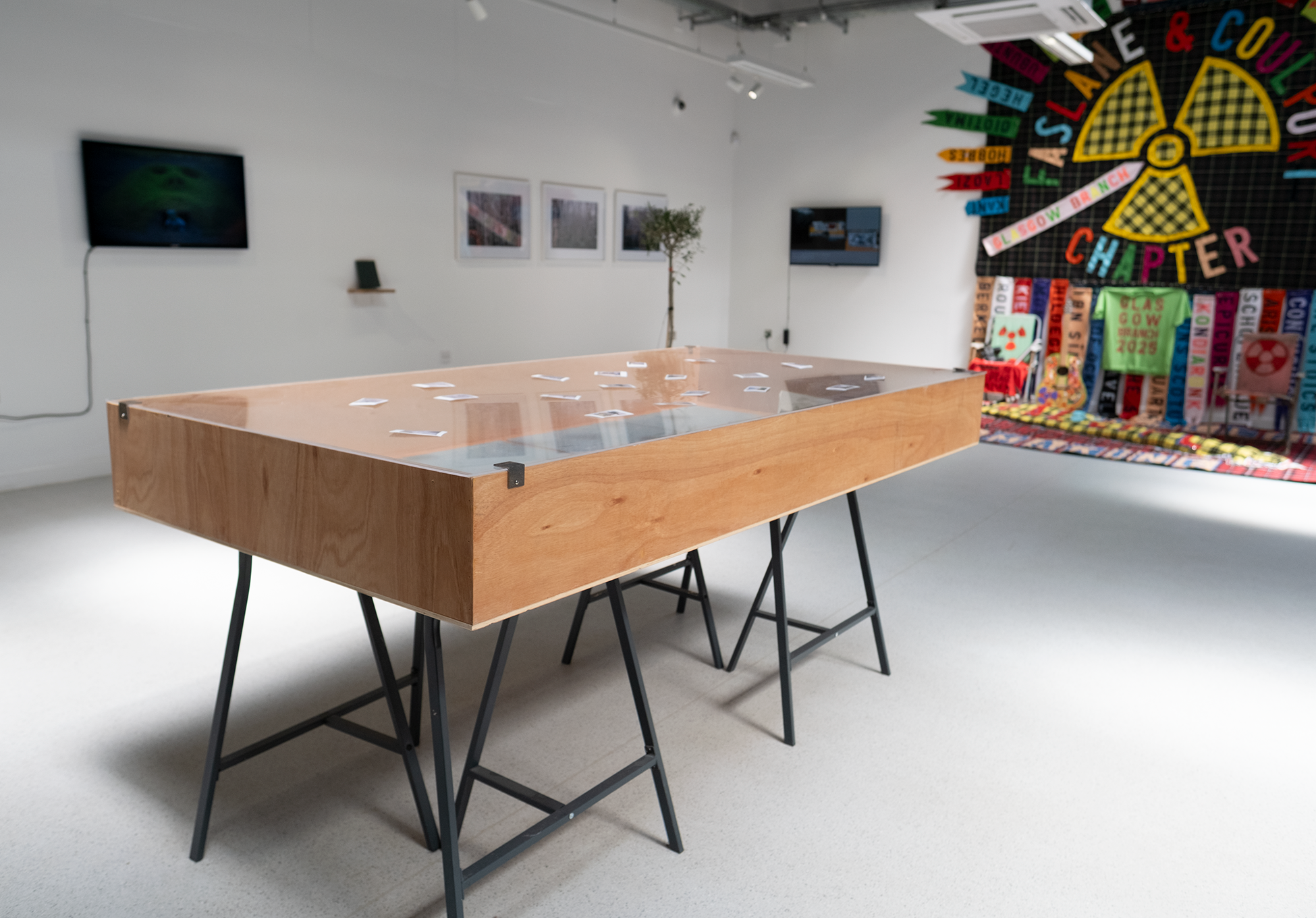
Susan Brind and Jim Harold, with Alex Hale, Hamiltonhill Claypits: After images, After things, After us, 2025, digital prints, polaroid photographs, notebooks. [Photo credit: Michael Mersinis] 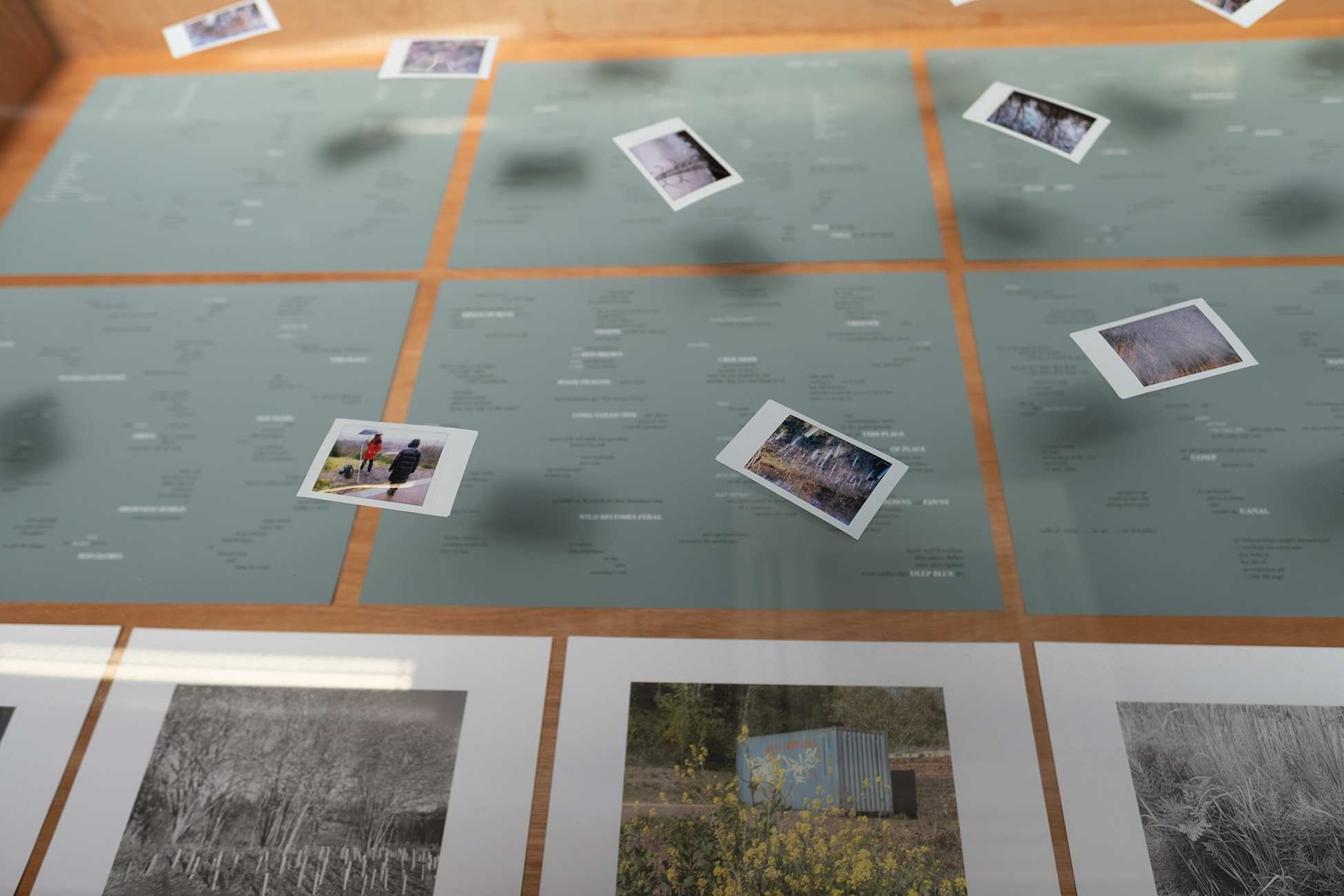
Susan Brind and Jim Harold, with Alex Hale, Hamiltonhill Claypits: After images, After things, After us, 2025, digital prints, polaroid photographs, notebooks. [Photo credit: Michael Mersinis] 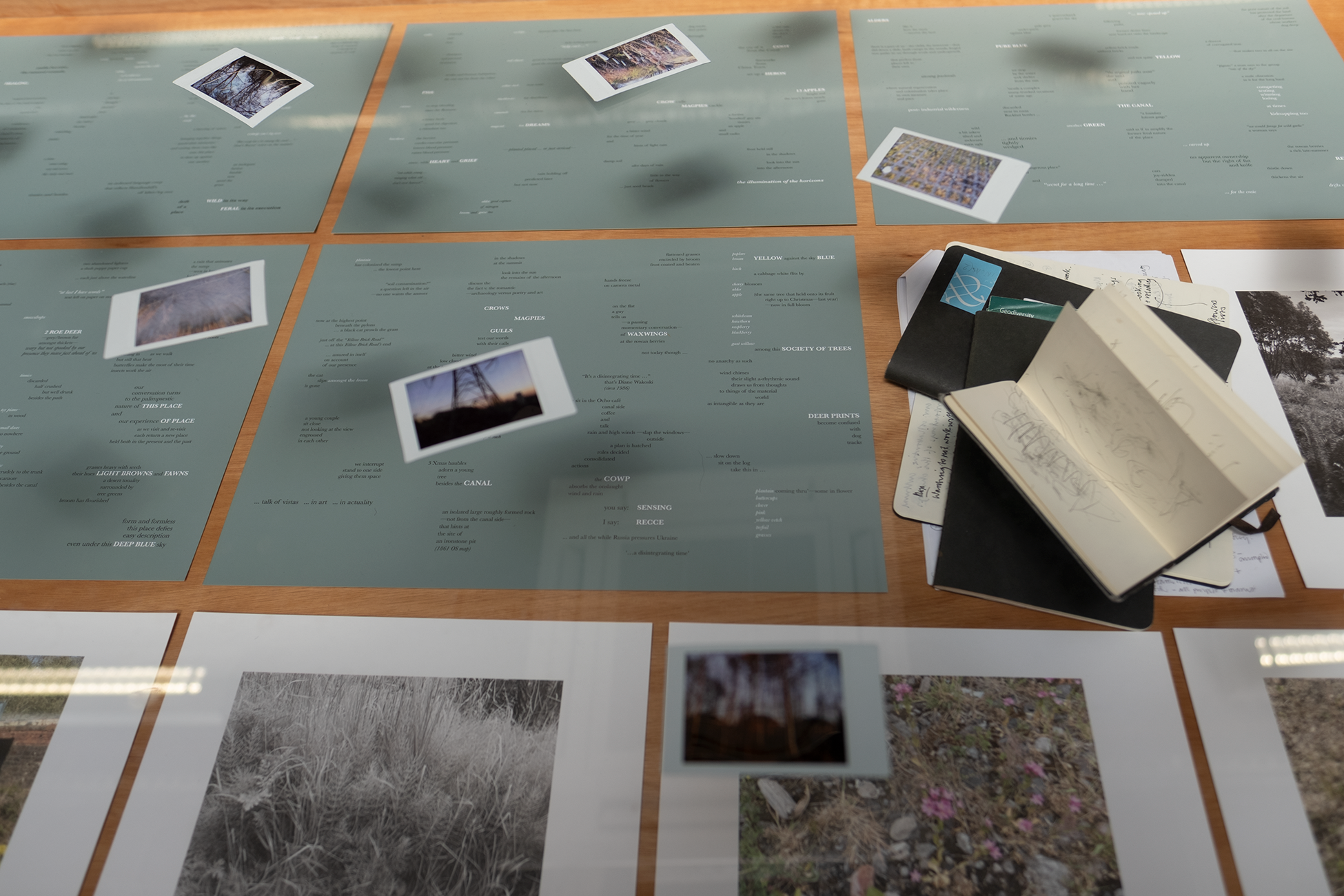
Susan Brind and Jim Harold, with Alex Hale, Hamiltonhill Claypits: After images, After things, After us, 2025, digital prints, polaroid photographs, notebooks. [Photo credit: Michael Mersinis]
These text works, digital prints, polaroids and research journals result from a collaborative process – involving practice-based and archival research, deep mapping and site writing – over a period of 3-4 years at Hamiltonhill Claypits. Our collaboration has formed a case study for the International Network for Contemporary Archaeology in Scotland, asking: What can our collaborative, cultural understandings of the changes (disruptions, ruptures and reclamations) witnessed at Hamiltonhill teach us about how we conceive and position landscape?
Hamiltonhill has a layered history: from rural landscape, once beyond Glasgow City bounds, to canal-scape and industrial hub, to post-industrial wasteland, now an eco-nature reserve. Our repeated visits – involving conversations, reflective events, sensings and recces – have accrued into palimpsest-like layers of experiences and meanings – not always logical – forming a landscape in flux. We have questioned historical, political, social, cultural, aesthetic and environmental, as well as ‘more-than-human’ readings shaping attitudes to landscape: this landscape, this place. The texts presented here are just one manifestation of works emerging from our research process.
For more information about our collaboration see the INCAScot website: https://scarf.scot/incascot/
Richard Mabey, The Unofficial Countryside (1973 revised 2010), Little Toller Books.
Timothy Morton, The Ecological Thought (2012), Cambridge, Mass: Harvard University Press.
Jane Rendell, Site Writing: the architecture of art criticism (2011), London: IB Tauris.
Rebecca Solnit, Orwell’s Roses (2021), London: Granta.
 Reading Landscape